What is the population of Monaco?

Monaco had 38,423 inhabitants on 31 December 2024, i.e. around 38,500 residents estimated at mid-2025. This demographic stability is a testament to the uniqueness of the Principality of Monaco, a sovereign state that fascinates with its history, culture and bold urban planning over an area of just 2.08 km² of Monaco. This small area contributes to making Monaco one of the most densely populated countries in the world, concentrating an exceptional population in a small area.
Discover our selection of apartments
for sale in Monaco
for sale in Monaco
Studios, one- to five-bedroom apartments, penthouses and prestigious properties
In addition to its resident population, the Principality sees its population double every day thanks to the influx of workers and visitors, confirming why so many people wonder why Monaco is known and are looking for a place that combines economic dynamism, prestige and quality of life. This daily effervescence contributes to the international reputation of Monaco, where the Rock and its unique past continue to captivate, as evidenced by the bewitching history of the Rock of Monaco.
For those who are planning to move to Monaco and join this cosmopolitan community, it is essential to know precisely the conditions for living in Monaco, especially for those who wish to become a Monegasque resident. Moreover, candidates coming from outside the European Union should find out about the detailed procedure for how to apply outside Europe, in order to prepare their project in the best conditions. Finally, at the heart of Monegasque life, the princely family remains an emblematic figure: as such, those who wish to deepen their knowledge can discover the history of the Princes of Monaco or learn more about the life and commitment of Charlene of Monaco, a true modern icon of the Principality.
So why is Monaco's population so large, how will it evolve in the coming years? In this article you will have an overview of what makes us expect an increase in it in the coming years.
A highly populated state in a small territory
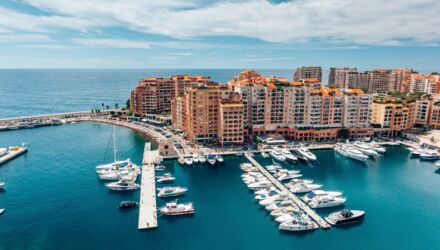
Monaco is the most densely populated country in the world. In 2023, there were an average of 18,446 inhabitants per km². This record density can be explained by a population of nearly 40,000 inhabitants concentrated in an area of only 2.08 km². The Monegasque territory has also expanded in 2024 with the inauguration of Mareterra, increasing the surface area from 2.02 to 2.08 km². Despite this small size, the Principality has managed to accommodate a large population thanks to high-rise urban planning and extensions to the sea.
This demographic pressure is felt on a daily basis. In addition to its permanent residents, Monaco sees tens of thousands of workers from outside the city flock every day. Around 50,000 jobs are held in the Principality for a population of around 80,000 people during the day. In concrete terms, nearly 86 % of employees working in Monaco live outside Monaco (mainly in neighbouring France and Italy) and make the journey to the city-state every morning and then leave in the evening. This commuting flow more than doubles the population present, sometimes congesting traffic and infrastructure, a challenge for the Monegasque government in terms of transport and urban parking.
How many inhabitants will there be in Monaco in 2025 ?
As of December 31 , 2024, Monaco had exactly 38,423 official residents (imsee.mc). This figure is up very slightly (+56 people, or +0.1 %) compared to the previous year. In the absence of a census published for 2025 to date, the population can be estimated at around 38,500 in mid-2025 , given the recent demographic quasi-stability. Monaco has thus exceeded the symbolic threshold of 38,000 inhabitants since the early 2020s .
In comparison, the Monegasque population was around 37,308 in 2016 and 32,020 in 2000. The graph below traces the evolution since the 2000s :
| Year | Resident population |
|---|---|
| 2000 | 32,020 inhabitants |
| 2016 | 37,308 inhabitants |
| 2023 | 38,367 inhabitants |
| 2024 | 38,423 inhabitants |
| 2025 (estimated) | ~38,500 inhabitants |
In a quarter of a century, Monaco has gained about 6,500 more inhabitants since the year 2000. However, Monegasque population growth has gone through contrasting phases. During the 2000s, the population remained almost stable : the 2008 census even recorded a slight decline (around 31,000 inhabitants) compared to 2000. This demographic plateau can be explained by the limited land and a moderate pace of new construction over this period. On the other hand, the 2010s saw a resumption of growth, thanks in particular to several large-scale real estate projects and Monaco's continued international attractiveness. Between 2008 and 2016, the Principality recorded a population of +5.5 %. Since 2020, the curve has tended to stabilize at around 38,000 souls.
According to long-term projections, the Monegasque population is expected to remain stable overall, or even decrease slightly, in the absence of major plans to expand the territory. The latest UN projections predict ~37,000 inhabitants in 2030 and ~36,600 in 2040 – a slight decrease due to ageing and net migration constrained by carrying capacity. Monaco could therefore maintain a population of around 36k to 38k inhabitants in the next two decades, unless there is a major new territorial extension or a proactive policy to increase the available housing. That being said, the Monegasque population is constantly increasing. This is probably due to the quality of life that the Principality of Monaco offers.
Distribution of the population by district
Administratively, Monaco is subdivided into different districts (or sectors). The population is unevenly distributed among these urban areas, reflecting the history of the development of the territory. Monte-Carlo (a district centred around the Casino and the Carré d'Or) is the most populous, as is the La Rousse-Saint-Roman district: between them, they account for more than 40 % of Monegasque residents. Conversely, Monaco-Ville (the historic Rock) retains a small population (around 1,000 inhabitants) due to its limited surface area and its heritage character.
The following table details the population by district according to the results of the census at the end of 2023:
| Neighborhood | Estimated Population | Share of Population | Visualization |
|---|---|---|---|
| Monte-Carlo | ~8,300 | 21,6 % | |
| La Rousse – Saint-Roman | ~8,000 | 20,9 % | |
| La Condamine | ~5,350 | 13,9 % | |
| Exotic Garden | ~4,760 | 12,4 % | |
| Fontvieille | ~4,450 | 11,6 % | |
| Les Moneghetti (Ravine Ste-Dévote) | ~4,300 | 11,2 % | |
| Larvotto | ~2,190 | 5,7 % | |
| Monaco-City | ~1,010 | 2,6 % |
It can be seen that the two most populous districts (Monte-Carlo and La Rousse) alone account for nearly 45 % of Monaco's inhabitants . These highly urbanized areas are home to many high-rise residences. This is followed by four medium-sized neighbourhoods – La Condamine (the Port Hercule district), the Jardin Exotique (on the heights to the west), Fontvieille (reclaimed from the sea in the 1970s) and Les Moneghetti – each home to between 4,000 and 5,500 residents (about 11 to 14 % of the total per district). Finally, Monaco-Ville (the Rock) and Larvotto (seaside area) remain the least populated, with 2.6 % and 5.7 % of the population respectively. In Monaco-Ville, the number of inhabitants (around a thousand) has remained modest due to geographical constraints and the presence of many institutional buildings (Prince's Palace, museums, cathedral, etc.). Larvotto, known for its beaches, is also sparsely populated apart from a few recent residential buildings.
It should be noted that the opening of the new Mareterra district at the end of 2024 (administratively attached to Larvotto) will eventually bring more than 700 new inhabitants. This extension project should thus slightly increase the population of the eastern districts of the Principality in the coming years.
Nationalities and population mix
Monaco is distinguished by its great international diversity. Ethnic (national) Monegasques are a minority in their own country : they represent only about 24 % of the population. In other words, nearly three-quarters of the residents are foreigners living in the Principality. This cosmopolitan diversity, nearly 140 nationalities are present on the Rock, gives Monaco a unique character.
According to the 2024 census, the main nationalities making up the Monegasque population are:
| Nationality | Number of residents (2024) | Share of population | Visualization |
|---|---|---|---|
| Monegasque | ~9,300 | 24,1 % | |
| Frenchwoman | ~8,470 | 22,0 % | |
| Italian | ~7,500 | 19,5 % | |
| British | ~2,900 | 7,6 % | |
| Russian | ~1,200 | 3,1 % | |
| Switzerland | ~1,200 | 3,1 % | |
| Belgian | ~1,000 | 2,6 % | |
| Other Nationalities (130+) | ~5,000 | 13,0 % |
Monegasques by birth form the first group with a little less than a quarter of the population (about 9,300 people). Notably, in 2023 they became the first nationality ahead of the French – a historic first linked to the granting of new naturalisations. The French make up the second largest group (just over 8,400 residents, or 22 %), followed closely by the Italians (about 7,500 , or 19.5 %). Historically, the French represented nearly 60 % of the inhabitants in 1962, but their proportion has fallen sharply over the decades, reflecting the internationalization of Monaco.
This is followed by British nationals (~7.6 %), who are the fourth largest group. There are also significant Swiss and Russians (3.1 % each), followed by Belgians (2.7 %) and Germans (2.5 %). Among the nationalities more modestly represented (less than 2 % each) are the Portuguese, Dutch, Americans, Australians, Scandinavians, etc. In total, 139 different nationalities live together in the Principality according to the 2023 census – a real international microcosm.
This cosmopolitan mosaic can be explained by Monaco's attractiveness to expatriates from all over the world. Security, climate, absence of income tax and exceptional quality of life motivate many foreigners to settle in Monaco (see our guide Moving to Monaco). Thus, Monaco attracts not only Europeans (French, Italians, British in particular), but also entrepreneurs, sportsmen and wealthy pensioners from America, Russia, the Middle East, Africa or Asia, who choose the Principality as their place of residence.
An ageing population with record life expectancy
Monaco's demographic profile is characterised by a high median age. Monaco has the highest median age in the world, around 56 to 57 years old according to recent estimates. In other words, half of Monegasque residents are over ~56 years old – a reflection of the marked ageing of the population. By comparison, the median age is about 42 years in France and 38 years in the United States.
Several factors explain this elderly structure: Monaco enjoys an exceptional life expectancy (the highest in the world, around 85-90 years old at birth), coupled with a low birth rate and immigration often made up of middle-aged people (well-off workers or retirees). The Monegasque age pyramid thus has a narrow base and a very wide top. According to the 2024 census, the 50-64 age group is the largest (23.5 % of the population), and nearly 27.5 % of the population is 65 years old or older (compared to ~20 % in France). Those aged 80 and over alone represent 9.4 % of residents, a remarkable percentage that illustrates the longevity in the Principality. There were 67 centenarians in 2024 (0.2 % of the population), a record in proportion to the number of inhabitants.
As a result of this demographic ageism, the average age of the population reached around 47 years in 2023, rising steadily (it was 45.6 years in 2008). The Principality is adapting its policies accordingly : state-of-the-art health services, residences for the elderly, specific social assistance, etc., in order to take care of a growing proportion of elderly people. At the same time, the authorities are encouraging families and young workers to settle in to maintain a generational balance – for example, through the construction of state-owned housing for Monegasques and facilities for expatriate workers.
In short, Monaco's population has a very unique profile: small in volume but extraordinarily cosmopolitan and affluent, with a high average age and record density. Although the Principality has only ~38,000 permanent residents in 2025, it shines well beyond its demographic dimension. Monaco embodies a prosperous micro-state where nationalities and generations live side by side, and whose measured growth contrasts with the intensity of its international attractiveness.
Entrust your real estate project to an expert in the Monegasque market
At Petrini Exclusive Real Estate, we put our expertise at your service to help you carry out your real estate project in the heart of the Principality. Specialising in the sale and rental of apartments in Monaco, we offer an exclusive portfolio of prestigious properties, ranging from refined studios to sumptuous penthouses with sea views.
Whether you are planning to rent an apartment in Monaco to enjoy its incomparable quality of life, or to know the rental costs in Monaco in order to prepare your budget serenely, our team advises you with discretion and efficiency.
If you want to become a homeowner, discover our guide to buying real estate in Monaco to find out everything about the process, find out about the costs of buying in Monaco and consult the latest trends in prices per m² in Monaco to guide your investment.
Thanks to our perfect knowledge of the local market and each Monegasque district, we guide you every step of the way to make your project a reality in the best conditions. Feel free to contact us today to discuss your needs and discover our bespoke real estate opportunities. Together, let's make your Monegasque dream come true!
Nos derniers biens disponibles
 Sole agent
3 700 000 €
Sole agent
3 700 000 €
Palais Belvédère · La Rousse - Saint Roman
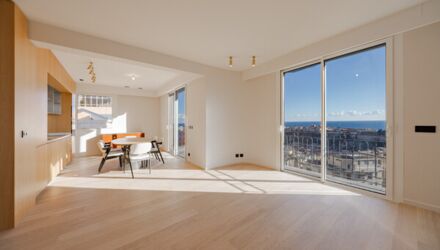
Bright 3-room apartment to renovate on a high floor, a stone's throw from Larvotto
Located on the 8th floor of a building with elevator, the Palais Belvédère is located in the sought-after area of La Rousse - Saint Roman. This 3-room apartment of 63 m² offers high ceilings and a beautiful view. A functional and ideally located apartment, close to the Boulevard d'Italie and the Larvotto. This apartment to refresh offers great potential for renovation to create an interior in its image.
 Sole agent
Price on request
Sole agent
Price on request
Palais du Printemps · Moneghetti
Magnificent renovated penthouse with sea views - Le Palais du Printemps
In the heart of the Moneghetti, discover this duplex penthouse, a perfect fusion between the elegance of a bourgeois building and a contemporary renovation. Climb up its internal staircase and let yourself be surprised by a large roof terrace, equipped with a pergola and a summer kitchen, revealing a breathtaking view of the Mediterranean Sea.
 10 300 000 €
Villa Minerve · Carré d'Or
6 ROOMS - VILLA MINERVE
In the heart of Monte-Carlo, a stone's throw from the Carré d'Or, this superb 6-room apartment of 185 m² under the law 887 offers a breathtaking view of Port Hercule.
Recherches fréquentes
Les derniers articles
Services and Everyday Life in Monaco
More Information

Contact our real estate agency in Monaco



In which district would you like to search for your future apartment?